
Updated 06-18-19. There are three main elements to every bowl of Vietnamese pho: the steamy, flavorful and aromatic broth; the meat, whether it is tenderly cooked chicken or beef that is rare or well-done; and the banh pho noodle. It's the banh pho that makes pho a noodle dish. Without banh pho noodle, it's a different noodle soup dish.
Many Vietnamese culinary experts will tell you that the life of pho is in the broth because that is where most of the flavors that characterize this dish are in. But just like you can't have a great pasta dish without exceptional pasta itself, one can also argue that the body of pho is in the banh pho noodle. Everything else - the fresh herbs, the bean sprouts, the sliced Serrano chili (or jalapeno in the U.S.,) the lime wedges and all the other fixings in the bowl - is just optional, nice to have stuff.
What is Banh Pho Noodle?
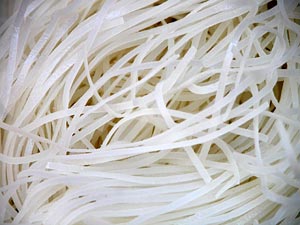 Let's start with a quick definition. Banh pho is the noodle used in pho dish. What differentiates banh pho from other rice noodle varieties is banh pho has square or rectangular cross-sections (depending on width size), as opposed to mostly round cross-sections most other noodles come in.
To make the square cross section of banh pho you have to create thin rice sheets, then cut them into strands. On the other hand, almost all round cross section rice noodles are extruded, which is similar to making spaghetti.
For the purpose of this discussion, I'll use banh pho and banh pho noodle interchangeably. Banh pho are noodles made from rice flour. In countries other than Vietnam, they are called chantaboon or rice sticks. Modern conveniences have seen banh pho sold as dry packaged varieties in supermarkets and grocery stores, but the ideal banh pho are those made fresh. These Vietnamese noodles are flat and white, with widths varying from a millimeter to a centimeter, or even wider (or 1/16" to wider widths of 1/8", 1/4" or sometimes even 3/8".) When banh pho is cooked, its texture becomes soft and chewy, and its appearance a bit translucent.
Banh Pho: An Essential Pho Ingredient
Why is banh pho so important in a bowl of pho? One can say that pho is not pho without the correct banh pho rice noodles in it. You can eliminate the garnishing, but you cannot take banh pho noodles out of a proper bowl of pho. And you can't have just few strands of banh pho floating in the broth, you have to have a whole lot of them.
In fact in a restaurant, it's totally an acceptable option to order more banh pho in your bowl than normally served (see the article on "Tips on Ordering Pho Your Way.") 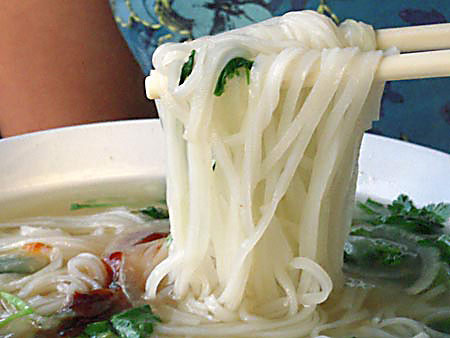
Here's another way of looking at it. In Vietnam and Southeast Asia in general, a meal is always composed of a main dish that is starchy and made of carbohydrates. These come in the form of either steamed rice or noodles. Dishes made from meat, seafood or vegetables eaten at the table during the meal are just side dishes that complement the starch (rice or noodle). There may be a soup side dish served along side the other side dishes. This is called "canh" in Vietnamese, and is often consumed in small bowl sized portion over rice or by itself during the course of the meal.
Banh Pho: The Foundation of a Pho Meal
A meal in Southeast Asia is never complete without the rice or the noodles, and when pho, hu tieu or any other noodle dish is the meal, the noodles are the foundation of such meal.
Vietnamese pho is a complete meal in a bowl. The broth serves as the soup, the rice noodles the starchy element, the meat as the protein, and the herb garnishing and the bean sprouts as the vegetable part. All these elements form a unified whole and the meal would not be filling (nor fulfilling) without the rice noodles. However, it is not enough that the rice noodles just exist in the bowl. In an Asian meal, the rice dish is so important that its quality dictates the tone of the entire meal. If one has to force down rice that was not properly cooked, it spoils the meal even if the side dishes were made for the kings and emperors. The same thing applies to banh pho noodle. Bad noodles make bad pho.
Banh pho should be fresh, with a slippery texture that is smooth enough for a good and easy slurp. If they are of the dried, supermarket variety, they should be prepared carefully. They should not sit in sticky clumps in the bottom of the bowl, and they should not be tough to chew on. Nor should they be so overcooked that they break apart when you pick them up with your chopsticks.
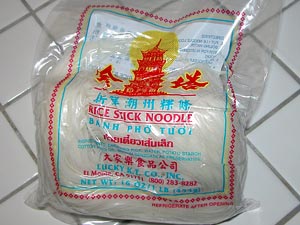 A Sample Package of Fresh Banh Pho Noodle A Sample Package of Fresh Banh Pho Noodle |
 Fresh Banh Pho Noodle Nutrition Facts: Serving Size 2 oz (56g), calories 150, sodium 240mg, total carbohydrate 35g, protein 3g Fresh Banh Pho Noodle Nutrition Facts: Serving Size 2 oz (56g), calories 150, sodium 240mg, total carbohydrate 35g, protein 3g |
How Banh Pho Is Made
As mentioned above, banh pho noodles are made from rice flour. Although the dried version is now available in supermarkets and grocery stores, these noodles are best when they are freshly made.
I've done some consulting with a banh pho factory in Vietnam, and the process is quite involved and takes real skills when done the old-school ways. Many factories nowadays use modern equipment to increase productivity, improve sanitary conditions, and maintain quality consistency with a lot less labor. Westerners may not approve of the sanitary conditions and standards at these "factories", but it is what it is. This is how people live in Vietnam.
Below are a few videos showing banh pho production using a mix of old-school/hand-made way with the help of some machinery. In the first video, be sure to watch toward the end when they actually cut the sheets into banh pho strands. Haha love Khánh Ly (the singer/artist in the first video for those not familiar) but kind of out of place for the subject matter. In the second, love those tourist kids!
Also check out Andrea Nguyen's article on How Pho Rice Noodles Are Made.
Preparing Banh Pho for Pho
Properly preparing banh pho noodles for serving in pho depends on whether you use the dry or fresh banh pho. If the banh pho is the dry type, then they should be soaked in hot water (or boiled) for 15 to 20 minutes, then drained and rinsed afterwards. The resulting noodles should be soft and translucent.
 Three Sizes of Dry Banh Pho Noodles Three Sizes of Dry Banh Pho Noodles |
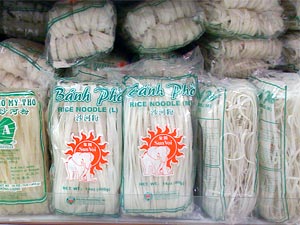 Variety of Dry Banh Pho at Local Asian Market Variety of Dry Banh Pho at Local Asian Market |
But if the banh pho is fresh, it should be rinsed under cold running water and then blanched in boiling water for no more than a few seconds, until the desired softness and translucence is achieved. The noodles are then placed in individual bowls, occupying about a third of the available space. Obviously those who like more noodles in their pho can add more banh pho as desired. Just remember to scale down on the other ingredients as the noodle will expand in the hot broth. The meat is placed over banh pho, and then the piping hot broth is ladled into the bowl.
Critically important note: regardless of whether the dry or fresh banh pho is used, if you're going to eat right away, then it's ok to just drain the steaming hot noodle, portion it into bowls, add all the good stuff, then ladle in the hot broth, and serve. This entire process should be quick and take less than 15-20 seconds. On the other hand, if you're not going to eat all of it right away, even within a few minutes or so, then the steaming banh pho coming out of boiling should be completely rinsed under cold water to 1) stop the cooking, and 2) prevent clumping. Once cooled, a few quick toss in the colander will air banh pho and allow it to sit at room temperature for up to a few hours until you're ready to eat.The Bottom Line: Pho Is not Pho Without Banh Pho
Substituting a different noodle may be acceptable at home but what you have then is "broken" pho. No self-respecting pho restaurant will serve pho without properly prepared banh pho, because it's just "wrong." If you run across someone serving pho with round noodles (bun or vermicelli,) demand your money back because it is something else and certainly not pho they're selling you. Or if you as a customer request a different noodle yourself, then pat yourself on the back for being adventurous, but please come back and order to correct banh pho next time 😉

I tired that brands banh pho and did not like it. It would always break and did not taste good. A better brand that my family use is Sincere Orient. It is also fresh made.
Hi Irene,
I totally agree with you. These fresh banh pho, and the brand your mentioned, Sincere Orient Food’s Bánh Phở Tươi are my recommendation too. There’s no reason why one should need to deal with the dry, packaged varieties that you have to boil for 10-15 minutes, then get a big mess afterward.
I have tried Banh Pho Hieu Ba Cay Tre or Three bamboo label and it’s one of the best. The texture and taste is the right consisitency.
Hi Thao Tran: I have never tried this brand as I don’t think it’s available in the U.S. I see this banh pho My Tho with the Three Bamboo Tree brand so it’s probably the same brand you are referring to.
Anyone know where I can buy these vietnamese noodles in the chicago area? Preferrably west suburbs..joliet..plainfield..naperville. Thanks.
@Cuong, it is available in the US. Where do you live?
@nshifter, they might not have it in Chicago, yet. Cities with a large Vietnamese community would carry them. I’m sure it’ll be on shelves in Chicago pretty soon. I’m actually eating right now (Bun Rieu Oc)
@Nshifter: On the map in the areas you specified, I can see Naperville Oriental Foods that you can try, or the Southwest Oriental Market in Orland Park. In general most Chinese or Vietnamese supermarkets or grocery stores will have the banh pho, but the brands you find will vary widely. Of course if you go Uptown you’ll find plenty I’m sure.
@Thao Tran: I’m all over Southern and Northern CA, and also in Seattle WA. I can’t say that I know all there is to know about pho brands, so I may have missed seeing this brand. Chicago does have a large Viet community so Nshifter will surely find banh pho. It can be rare in the suburbs he mentioned though.
Bun Rieu Oc? wow haven’t had that for ages 🙂
Hi. I really want to find a recipe for making bahn pho noodles at home. I only found a video but no recipe on the ratios of rice or rice flour, to water. 🙁 Can you help me?
I use this video as a guide because it’s the closeting thing I could find! T^T http://www.youtube.com/watch?v=OLNyM_yqIlM
Raisha: I don’t think I can help you here. I have not attempted to make it myself, but I would think making banh pho noodle/spaghetti/pasta should be simple process of extruding rice dough into boiling water and cooking it, or cutting freshly steamed, thin dough into strands. The key I think is not the process, but you have to have the right tools and work at it to develop the skills.
Here’s one you can enjoy and learn from (in Vietnamese): Banh Pho Ba Ngoan
And here’s another one, go to 4:21 time mark (in english): Making banh pho from Vietnamese Food Documentary
Does anyone know a banh pho brand that is square shaped??..i keep running into rectangle shaped ones. preferably the fresh variety..please enlighten..thanks
@Truong: Banh pho comes in various widths ranging from 3mm to 10mm (that’s millimeter) in the dry bags. At the smaller width of 3mm you essentially have the square cross section preferred by many people for pho. At the larger width of 10mm you have something people use in Pad Tai. Even larger sizes are used for dishes like chow fun or pan fried noodle. So look for the correct size where you buy the dry banh pho.
For fresh banh pho, I think you’re more likely to find only the small size. You didn’t mention where you live so three’s not much I can help you with.
@Cuong..im in the houston tx area..
So ur saying square shaped noodles only come in the dry variety?..
No Truong, actually that’s not what I am saying. I said “For fresh banh pho, I think you’re more likely to find only the small size,” meaning they only make them small size, so you shouldn’t have a problem finding them. If you’re in Houston, then you should have no problem finding the fresh banh pho from many Viet/Asian supermarkets. It’s a sure bet the you can find it in:
99 Ranch
http://www.yelp.com/biz/99-ranch-market-houston#query:Asian%20Supermarket
or
Viet Hoa
http://www.yelp.com/biz/viet-hoa-international-foods-houston#query:Asian%20Supermarket
etc.
You’ve never seen these?
http://xuandirecipebook.files.wordpress.com/2012/08/2012-08-19_09-55-07_102.jpg
http://a3.img.mobypicture.com/9bee725b77935069bdf287a79103e020_view.jpg
Good luck Truong.
Thanks Cuong!!
Well, I guess I did okay on the trip to the Asian market yesterday. Bought EXACTLY what you have pictured on the left above for the dried banh pho without speaking to anyone. My cilantro won’t be up for a couple of months, but I can add the chicken and peppers (lots for me). My spice cubes were only $0.49/four. And I did get them for pho ga.
@Jeff: Congrats on the banh pho, but maybe not so much for the spice cubes if I understand correctly. Do you make pho broth from scratch or use cubes like bouillon cubes for the broth? I’m not judging at all, just asking 😉
Also it sounds like you grow your own cilantro? Awesome, and fresh too!
Hi,
I’m searching for Banh Pho, Rice Noodle machine to make fresh rice noodles in California.Is anyone know any best machine out there in VietNam?Thank you.
@vinhtruong: I’m not familiar with “best machine out there in VietNam” so can’t recommend one for you. For something not in use widely, you’ll probably have to do the legwork yourself. There are restaurants in the US making their own banh pho in-house (some of which are mentioned in Andrea Nguyen’s article; I also know a couple others) and the results are not always ideal.
You didn’t say if you plan to use the machine as part of restaurant production or if you plan to open a new manufacturing production like Sincere Orient. Either way you’ll want to make sure they are NSF approved since almost health departments require it, though I doubt any of these Viet-made or Chinese-made machines are NSF approved.
I agree with Andrea in that it doesn’t really buy you much to produce your own banh pho in-house like making pasta in-house. Your cost-benefits analysis will probably not support it unless you are absolutely tight with your banh pho making process. Also if your machine goes down, you won’t get same-day or next-day support/repair; may not even same-week or same-month support.
Hit me up for further consultation if you’d like. I’ve helped a production facility in the past and can walk you through the detail.
Banh pho making machines come in different sizes and capacities and require varying floor space. I think like any other machine or piece of equipment, you’ll want to specify what you plan to do (capacity like pounds per hour, pounds per day, etc.) before looking for (or receiving recommendation on) a machine. Also a “machine” may not be a single piece of equipment. It may include several different pieces, such as the rice grinder (if you don’t use rice flour) and mixer (to control the texture you want, using corn flour or tapioca), the boiler/steamer, conveyor belt, cutter, etc.
Having a good production process is critical, and as Cuong mentioned, keeping the machine running / maintenance may be a big challenge too.
I love pho and eat out a lot, consistently once or twice a week. There has been only once or maybe twice that I ever encountered problematic or poor quality banh pho. One time was lumpy/overcooked/break-apart in my bowl, the other time was mushy/break-apart issue. Sent back both times and got a new bowl with no trouble. I think both times were attributable to lazy or untrained kitchen staff rather than banh pho quality itself. I may be wrong but I don’t think most people can tell “fresh” banh pho from “non-fresh” banh pho in a steamy hot bowl unless it was totally cooked incorrectly or cooked and left out for too long.