
Updated 06-19-19. There are three elements that make up a bowl of Vietnamese pho: the broth, the rice noodles and the toppings (meat, garnishes, etc.)
If you are a pho lover, you may be a fan of the noodles or of the way the meat, herbs and spices play together in your mouth as you slurp your pho to the last drop. Regardless, there's no denying that the pho broth is the most important element of Vietnamese pho. Pho broth is the soul of the dish. It is what makes the dish Vietnamese pho.
It's not a bowl of pho until the broth goes in.
Pho note: This article on Pho Broth is both a how to make pho broth and a philosophical look at the meaning of the broth in pho. If you are looking for the nuts and bolts of making pho, go directly to the latest Beef Pho Recipe infographic, or check out these 2 articles: Top Pho Bo and Pho Ga Recipes You Must Try Yourself and Quick Beef Pho Recipe with Quoc Viet Foods’ Pho Soup Base.
Giving Meaning to the Soul of Pho
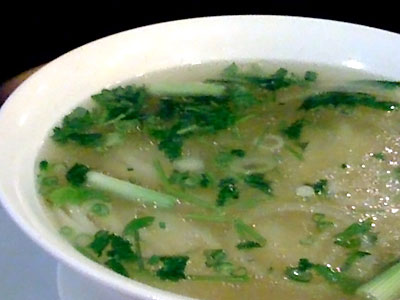 Can you imagine Vietnamese pho without its broth? It is probably impossible to do so. You may try to cook up all kinds of soups, pour it in the bowl and try to call it pho. You may resort to be creative with different meats and adding new herbs and garnishing to the mix, but it's just not pho. The pho broth is what gives the soup its distinct character. There's not necessarily only one way to make pho broth, but a good pho broth must follow certain rules and standards.
In fact, the key to a successful bowl of pho is the creation of a good pho broth. Pho lovers judge the bowl of pho served to them in a restaurant by sipping the broth first without putting in any seasoning or garnishing.
I see many people (mostly non-Viet and younger Viet generation) dumping in sriracha and/or hoisin sauce into their pho as the bowls arrive at the table. My question is, don't they wonder how the broth tastes? Is it good or is it not good pho broth? If it's not good pho broth then maybe they should try a better place.
But I digress. If there's any doubt about the quality of a bowl of pho, just take a sip of the broth to find out. If the pho broth is good, we feel immediately at home; the familiar, the warm, the good, the satisfying. But if the broth is not up to expectation, the pho eating experience becomes labored, beside the fact that one is wasting the time and money with this darn bowl of pho.
You can be forgiven for serving undercooked or overcooked banh pho (the pho noodle). You can be forgiven for not having all the right meat types or garnishing. But mess up the pho broth and your pho is ruined. Conversely, serving a great pho broth will make up for your other shortcomings many times over. There is no one perfect technique for making pho broth, but with practice and attention to to basic techniques, one can create a very good broth, with the right pho taste.
How to Make Pho Broth
There is no single perfect technique for creating good pho broth.
Many Vietnamese say that the best pho you will ever taste is the one cooked by your own mother, grandmother or other matriarch of the family. Such person would have very strong preference of how good pho broth is made. These ideas and knowledge, in turn, are handed down from generation to generation. I can tell you, this is more of a myth than fact, but will be the subject of a different post.
For now, let's move on to making a good pho broth.
Oh one more thing: the following is more applicable for home made pho. For restaurant operation which must produce very large quantity of pho with consistent quality day in day out, the specific process, procedures, equipment and number of staff/cooks are much different, more demanding, and certainly a lot more involved than shown here.
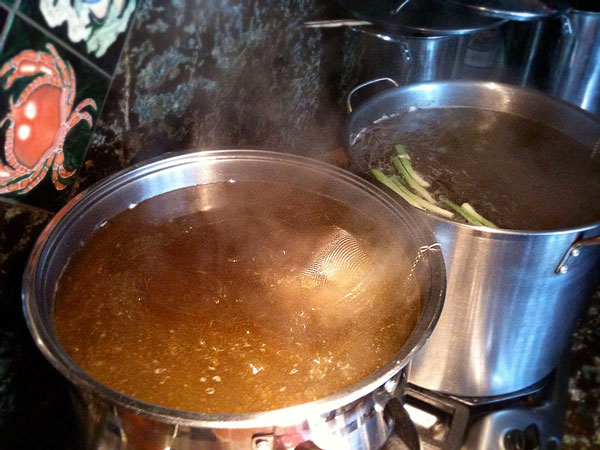 Almost all pho recipes will have many common elements between them, from the ingredients that go into the broth to the length of time required in making it. Vietnamese culinary experts Andrea Nguyen's and Mai Pham's beef pho recipes call for the following ingredients:
- Yellow onions
- Ginger
- Marrow-rich beef bones and beef knuckle bones
- Additional beef chunks
- Star anise
- Cloves
- Salt
- Fish sauce
- Yellow rock sugar
Here's a generic process. Many recipes call for preparation using two stockpots of boiling water. The beef bones and chunks are parboiled in one pot in high heat for up to five minutes. This is to remove all the impurities on the outside of the beef. Andrea Nguyen recommends rinsing the bones in warm water before being transferred into the second stockpot, while Mai Pham says that it is fine to just transfer the bones and the chunks without rinsing. If you have room for 2 large pots, then use 2 pots; it will save you a lot of time while keeping your stock pure. But if you can use only one pot, then it will work too.
In any case, the second stockpot is kept at a simmer for an hour and a half, with any scum rising to the top skimmed out regularly. The spices are then added, either as they are or wrapped in cheesecloth. Before they are put into the broth, the onions and the ginger need to be charred in open flame. Mai Pham recommends toasting the star anise and the cloves lightly in a dry pan before they are put into the pot. Again techniques vary, but either roasting or charring will help release much more of spices' fragrance.
After the hour and a half has passed, the boneless beef chunks are removed. The remaining broth is allowed to simmer for another hour and a half or so. The pho broth is then strained and seasoned with fish sauce, salt and rock sugar. At this point, the pho broth should look clear and free from impurities. It is perfectly acceptable for it to taste strong and even salty at this point as well because the taste will be toned down once the broth is poured over the unseasoned rice noodles and meat.
The procedure described above is the most generally accepted way of cooking pho broth. But no two bowls of pho made from two separate kitchens ever taste the same, and techniques on how to make the broth vary from kitchen to kitchen. Some cooks, for instance, do not put fish sauce in the broth but instead leave it up to the guest to season it as he or she pleases. Some cooks also skip on adding beef chunks into the simmering broth and rely solely on the flavor of the dissolved marrow.
Note:
You should never let water evaporate completely to dry-out condition. If your pot dries out after a few hours of “simmering” then you’re probably boiling it the whole time, or don’t have enough water to begin with. You should be keeping an eye on the simmering and skimming the scum as needed. So just turn down the heat to have just a light rolling action in the liquid.
Most recipes should specify a yield amount, such as yield = 3 gallons. This means that at the end (or sometime during simmering as needed), you’ll need to add water to bring up to the yield amount. If this is the first time you make pho broth, then I suggest to follow the recipe first and see how it comes out, then make adjustments to fit your taste.
Time Is Essential in Cooking Pho Broth
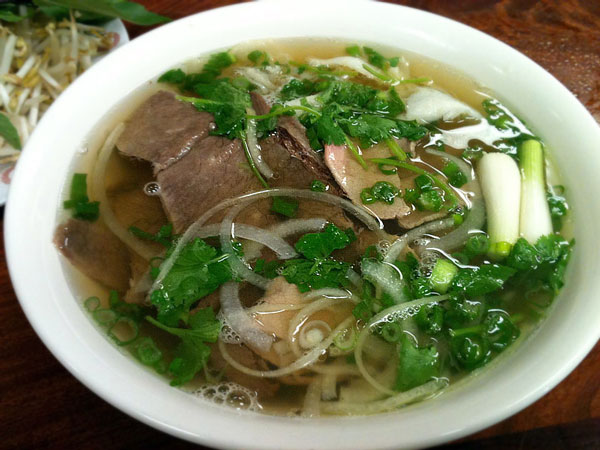 Perhaps the one thing that turns people off from making their own pho at home is the amount of time it takes to create the pho broth. There are stories of people hailing from Vietnamese immigrant parents all over the Internet, which say that their own mothers have given up making pho because of the time needed to cook it. If they want pho, they all go to a restaurant that serves pho to fulfill their craving for the dish.
How long should it take for beef bones to simmer in order to come up with a good pho broth? Mai Pham and Andrea Nguyen both recommend at least three hours to simmer the broth, but there are other recipes that state that the beef bones must be boiled gently for six to eight hours. For restaurant-quality pho, the time required to simmer the broth can take up to 12 hours or more.
Why is it necessary for the boiling to take that long? The explanation is simple: It takes time for the marrow in the bones to dissolve into the water. You cannot force it with shorter but harder boiling because a hard boil distorts the flavor of the pho broth. The flavor of the marrow is the essence of the broth; it must be brought out gently and doing so takes time.
The time it takes to create pho broth is definitely worth it, though, and you will end up with a broth that is so tasty you will want to slurp up every last drop. Some people resort to buying so-called pho broth cubes or canned pho broth, but the taste is just not the same. It is thin and watery compared to homemade or restaurant-made pho broth. I know, I know. Those are just quick fixes for a quick pho but I just had to mention them.
Pho is not pho without its broth. The broth is the element that gives pho its life and soul. If you can enjoy the pho broth wholeheartedly, then the rest of the ingredients in the bowl will be enjoyable too.


Hi korean recipes soak meat in cold water a half hour to remove blood and impurities before cooking to get a clear broth. Could this method be used for pho instead of parboiling and washing?
@K: Korean cuisine has many different recipes for stocks and broths for different dishes. I’m not sure what specific dish you’re referring to, but many Korean dishes actually do not require having clear broths. While some recipes do call for soaking meat in water (I assume you mean beef in this case), I don’t think soaking alone before cooking will give you a clear broth. It would be helpful to see your recipe and understand what it’s trying to accomplish.
For the clearest broth possible (which is what pho requires, and for dishes requiring clear broth), most well-trained chefs and other foodservice professionals would probably agree that parboiling and low simmering would give you a clear broth. This is exactly what I recommend as well.
Another consideration worth noting:
Supply chain for food ingredients are not the same in many Asian countries when compared to Western countries. Even by today’s standards, Asian meat products still have a much shorter time and distance between when a cow is slaughtered and when people purchase the meat from the market. This means the meat one gets to cook in his/her kitchen may be much fresher and at the same time not as “cleaned” as its Western counterpart.
As a result, people had to do further cleansing in their kitchen before actual cooking, initially out of nessesity then becoming a habit over time. This is still true in many rural areas in Vietnam and probably in many other places around the world. It is certainly true for any protein that’s not been done through a commercial slaughterhouse.
I’m sure “family” recipes that have been passed from people to people and from place to place may not have been properly updated to account for new or more modern food supplies, availability, and quality standards. For this reason alone, I always review recipes closely to ensure they make sense before going into full production for service in a particular restaurant. Anything that needs updating will be updated.
Bottom line? 1) Don’t always trust a recipe; 2) make sure it’s from a reliable source, and 3) understand why certain thing or technique is done.
Hey, maybe it will look stupid question but is it okey if I cook pho 12 hour or even more with all the spices like cloves and star anise or is better to throw them last hour or so. Is it even difference? How do they make in restaurants?
@Alek: I’m not sure what recipe you’re using, what it’s telling you to do and what ingredients to use, but 12 hours seems excessive. Not that it’s not doable; many have done it successfully (see Chung’s comment). If you do go for this long, then you’ll want to make sure to do these two things: keep skimming the scum and maintaining proper water level.
With respect to your question about the spices, it has been discussed before. You can read Roy’s comment about spices, and also check out my post on How Long To Cook Pho Spices In Pho Broth.
Working as a pho restaurant consultant, I see restaurants do all kind of things with the spices depending on the owner’s preference. My recommendation for using the spices is just as written in the post referenced above.
I sometimes make Pho if I’m serving several people and I enjoy preparing it but I live alone. So if I order Pho take-out/delivery, I always get it deconstructed. I want to see everything. I taste the broth first and go from there. So, last night, I had some delivery. Perfectly deconstructed. First thing I taste is the broth. Too sweet, no mouthfeel, no globules of happy fat floating on the surface. Obviously, this was made with pre-fab stock. There was no collagen (that’s the mouthfeel part). I took some to refrigerate overnight to setup…nope, still liquid. I had to fix the broth by adding fish sauce, fresh ginger, garlic, and other seasonings until it tasted like something resembling Pho stock. Unfortunately, there is no quick fix for the lack of collagen. After putting together a bowl, I decided I would salvage the noodles and turn them into a salad the next day then m/b adding some beef to the broth and ending up with a new stock? I don’t think it’s worth the effort for the broth. The thing is, so many restaurant goers don’t have any clue as to how real Pho stock should taste. There’s no one way of making it but there are certain qualities the stock should possess. Just a note: I use the terms stock and broth interchangeably. Lol.
@Chieko: If you can make pho at home that suits your taste and have the time to do it, then as I’ve suggested elsewhere, it’s still better to make the broth in bulk, then freeze what you don’t need, and use just what you want when you want it. This way you can avoid wasting money with such bad takeout pho. In the end we should vote with our reviews and more importantly, with our wallets. By definition, the bad restaurants will have to improve or risk going out of business. But as you said, many restaurant goers can’t tell the difference, which is how bad restaurants still stay in business.
you can buy sa sung in the states now from a company in San Jose. http://www.sasungusa.com
@John Nguyne: Wow, I know what sa sung is, but the vast majority of people do not, so if you’re trying to promote something, at least give the audience some useful information so they care, right? Just saying.
I tried Pho for the first time just a month ago at a restaurant in London (it only took me 50 years) and was amazed by how much flavour could be packed into such a watery broth so I thought I would try making it with a technique almost identical to how you described. I was so pleased with the results that it is definitely going to be a regular on the menu at home, even my fussy kids enjoyed it.
Thanks for the article though, I enjoyed reading all of it. I was hunting for tips on getting a clearer broth and reading this, I need to make sure I get the parboiling right up front. I guess I didn’t realise how important this step is.
@Phil: Yes when it comes to pho broth, attention to detail is required; the right detail that is. In the grand scheme of things, parboiling correctly and simmering properly are probably two of the biggest factors that will give you clear broth. Hope you achieve your goals there. Best of luck.